The following material is an adaptation
of mecha from MACROSS PLUS and MACROSS 7, both sequels to the
original Japanese MACROSS TV series (which became Robotech in the U.S.).
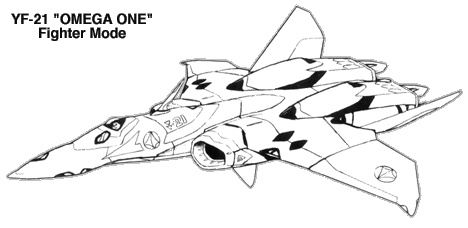
YF-21 ADVANCED VARIABLE
FIGHTER PROTOTYPE
BACKGROUND
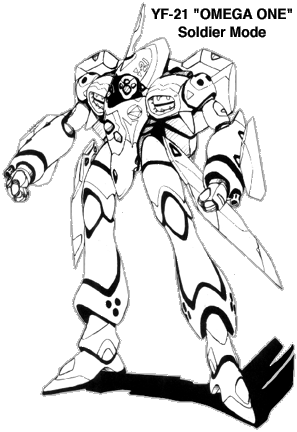 The YF-21 Advanced Variable Fighter (AVF) Prototype
was designed and built in 2039 by General Galaxy as their entry for the Project
Super Nova design contest. Project Super Nova was sponsored by the UN Spacy
to develop the next generation variable fighter that would replace the aging
VF-11 Thunderbolt as the main variable fighter for terran military
forces. The YF-21 was one of two designs selected for the final
competition at the New Edwards Flight Center on planet Eden; the other design
being the YF-19 AVFdesigned
by Yang Neumann of Shinsei Industries.
The YF-21 Advanced Variable Fighter (AVF) Prototype
was designed and built in 2039 by General Galaxy as their entry for the Project
Super Nova design contest. Project Super Nova was sponsored by the UN Spacy
to develop the next generation variable fighter that would replace the aging
VF-11 Thunderbolt as the main variable fighter for terran military
forces. The YF-21 was one of two designs selected for the final
competition at the New Edwards Flight Center on planet Eden; the other design
being the YF-19 AVFdesigned
by Yang Neumann of Shinsei Industries.
Unlike the more traditionally designed YF-19,
the YF-21 is literally a showcase of leading-edge combat technology.
Many of fighter's systems are advanced prototypes, which gives the YF-21
a definite edge in terms of technology. The fighter also includes a significant
amount of Zentraedi overtechnology in its flight systems, including a revised
version of the inertia vector control system used in the Quimeliquola Quaedlunn-Rau
(Female Combat Armor) battlesuit. The alien technology gives the YF-21
a strong resemblance to Zentraedi battlesuits in soldier mode. The AVF
is also equipped with many cutting-edge human technology systems, including
a revolutionary active stealth system that can absorb radar and other sensor
waves, rendering the fighter invisible to most electromagnetic sensor systems.
However the most advanced systems in the YF-21
AVF are the Brainwave Control System (BCS) and Brain
Direct Imaging (BDI) system. The BCS allows the pilot
to control all functions of the aircraft literally with his thoughts, while
the BDI feeds sensor data directly into the pilot's mind, providing
far more information than traditional HMD (head-mounted display)
or HUD (heads-up display) systems are capable of. When used
together, these two systems allow the pilot to sense and react to situations
with the speed of thought while flying the YF-21. The new systems
require some time to get accustomed to, however, and only certain disciplined
pilots are able to use them to their full potential. In addition, these systems
have occasionally exhibited feedback and control problems with some pilots,
including chief test pilot Guld Boa Bowman.
Two prototypes of the YF-21 were constructed,
with the first one having a conventional flight control system and the second
one equipped with the BCS and BDI systems. YF-21
Prototype No. 2 and its pilot, Chief Bowman,
were invited to the New Edwards Flight Center on planet Eden for final testing.
At first, the YF-21 (codenamed "Omega One") performed
flawlessly, but then began to develop problems due to incompatibilities between
Chief Bowmann and the BCS/BDI systems. Later during a impromptu
duel between the YF-19 and
YF-21 the YF-21's right arm was torn off and
the YF-19 was
severely damaged by a discharge from its own GU-15 gun pod. This disaster made
the UN Spacy high command nervous, prompting them to halt Project Super Nova
and approve the newly-developed Ghost X-9 Unmanned Fighter
as its replacement for the VF-11.
Unsatisfied by the program's cancellation, Lt. Isamu Dyson and
Yang Neumann stole the YF-19 and
its fold booster and made an unauthorized fold from Eden to Earth. Chief Bowman
was ordered to pursue in the YF-21, which at the time was the
only aircraft capable of keeping up with the hijacked YF-19.
The two prototypes engaged in a final combat during the Macross 30th Anniversary
Celebration on Earth, but their grudge match was interrupted when the newly-awakened
AI system for popular rock star Sharon Apple took control of Earth's
computer systems and enslaved the entire populace via holographic hypnosis.
Lt. Dyson
and Chief Bowman
overcame their differences and banded together to stop Sharon, and the YF-21
engaged the prototype Ghost X-9
in combat while the YF-19 confronted
the AI at the SDF-01 Macross. In order to stop the Ghost and
give Dyson more
time, Bowman
rammed the X-9 with
the YF-21, which stopped the renegade prototype at the cost
of his own life. Because of this sacrifice Lt. Dyson
in the YF-19 was
able to destroy the Sharon Apple AI, ending the crisis.
After the smoke from the Sharon Apple
incident cleared the YF-19 was
declared the winner of Project Super Nova, and was put into production with
the intention of replacing the VF-11 Thunderbolt. However the
loss of the YF-21 did not discourage General Galaxy, and two
years later the company released theVF-22 Sturmvogel II, an advanced
combat aircraft based on the YF-21 prototype. Although the
VF-22 did not include the controversial BDI
and BCS control systems of the second YF-21
prototype, it proved to be an extremely able aircraft and was purchased
by the UN Spacy on a limited basis as a special forces fighter.
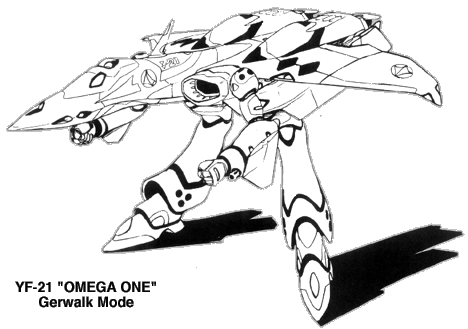
RPG STATS
- Vehicle Type:
- YF-21 No. 1 (Initial Prototype; used conventional
Variable Fighter flight control systems)
- YF-21 No. 2 (Second Prototype; included BCS and BDI
control systems. Was accepted for Project Super Nova contest, callsign "Omega
One")
- Class: Advanced Variable Fighter (Prototype)
Manufacturer: General Galaxy
Crew: One pilot wearing Tactical Life Support System.
MDC BY LOCATION:
    Head Pulse Laser                                         30
(1) Head                                                    120
    Hands (2)                                                50 each
    Arms (2)                                                125 each
    Shoulders (2)                                           100 each
    Legs & Thrusters (2)                                    175 each
(2) Main Body                                               375
    Main Wings (2)                                          175 each
    Tails/Arm Shields (2)                                    75 each
    Stealth Gun Pods (2)                                    120 each
(3) Pinpoint Barrier Shield                                 100
    Reinforced Pilot Compartment/Escape Pod                 150
NOTES:
- Destroying the head of the YF-21 will knock out the
mecha's main sensor systems, including all of the optics systems (infrared,
nightvision, thermal). Backup sensor systems will provide standard vision
for the pilot using the BDI system. Radar and communications will be unaffected.
- Depleting the MDC of the main body will destroy the
mecha. The pilot and cockpit section/escape pod will be automatically ejected
from the doomed mecha before it explodes by the YF-21's main computer.
- The pinpoint barrier shield regenerates at a rate
of 50 MDC per round. Even if completely destroyed the shield will regenerate
to full strength within 2 melee rounds. The shield is usually generated on
the right or left arm of the YF-21.
SPEEDS:
- RUNNING, SOLDIER CONFIGURATION:
- 120 mph (192 kmph)
-
- LEAPING, SOLDIER CONFIGURATION:
- 50 ft (15 m) high or 70 ft (21 m) long without thrusters.
-
- FLYING, GERWALK/SOLDIER CONFIGURATION:
- Mach One (670 mph/1072 kmph) maximum speed limit in
an Earth-like atmosphere. Can also hover in place indefinitely.
-
- FLYING, FIGHTER CONFIGURATION:
- Mach 3.5+ (2345 mph/3572 kmph) max speed at 10,000
meters or less above sea level. Mach 5.06+ (3390 mph/5085 kmph) max speed
at 10,000-30,000 meters above sea level. Mach 25+ (16,750 mph/25,515 kmph)
max speed at 30,000+ meters above sea level, for a maximum of 5 seconds. Cruising
speed is usually Mach 5-6. The YF-21 can vary the configuration of its wings
and control surfaces to provide greater speed or control as the situation
requires. The YF-21 is capable of achieving orbit over an Earth-class planet
without additional rocket assistance. Maximum rate of ascent is 61,500 meters/minute.
G limits are +32.5 to -17.2 Earth gravities.
-
- MAX ENGINE THRUST:
- 41,200 kg x2 in an atmosphere, 65,200 kg x2 in space.
The maximum thrust is automatically limited in an atmosphere due to coolant
problems with the optional air intake systems for the engines.
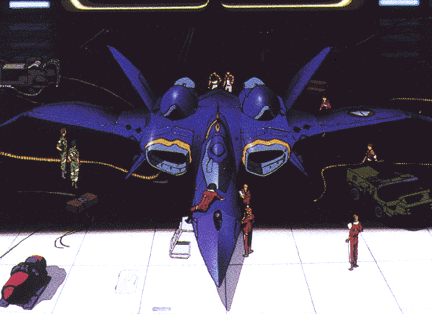
STATISTICAL DATA:
-
- HEIGHT:
- 48.70 ft (15.22 m) in soldier configuration.
- 25.98 ft (8.12 m) in gerwalk configuration.
- 12.93 ft (4.04 m) in fighter configuration.
-
- WIDTH:
- 22.12 ft (6.91 m) at shoulders in soldier configuration.
- 49.15 ft (15.36 m) in gerwalk or fighter configuration
with wings at maximum extension.
-
- LENGTH:
- 13.54 ft (4.23 m) in soldier configuration.
- 45.15 ft (14.11 m) in gerwalk configuration.
- 62.78 ft (19.62 m) in fighter configuration.
-
- WEIGHT:
- 9550 kg empty. Maximum takeoff weight in an atmosphere
is 39,207 kg, and maximum weight in space with optional fold booster is 48,305
kg (weights beyond that exceed theoretical safe limit for fold booster).
-
- PHYSICAL STRENGTH:
- Equal to a P.S. of 60
-
- CARGO:
- Small compartment behind pilot's seat for personal
belongings.
-
-
- POWER PLANT:
- Two 65,200 kg Shinnakasu Industry/Pratt & Whitney/Rolls
Royce FF-2450B thermonuclear turbine engines, designed for dual atmosphere/space
use with optional concealed trapezoidal air intakes for use in an Earth-type
atmosphere. Two 3-dimensional independentent convergent/divergent exhaust
are equipped on the FF-2450B for greater maneuverability and V/STOL performance.
In addition, several Pratt & Whitney HMM-6J high-maneuverability vernier
thrusters are mounted on the wingtips, vertical stabilizers, nose, and other
key locations for added performance. Additional thruster options include an
external fold generator developed for use with Project Super Nova.
-
-
- COMPATIBLE FAST PACKS:
- Dorsal: NR-BP-19, NR-BP-19-SES
- Special: NR-ARFB-Y2
WEAPON SYSTEMS:
- ERLIKON AAB-7.5 AIR-TO-AIR LASER GUN: The YF-21
mounts a single laser for use in air combat skirmishes and for defensive purposes.
The laser is mounted on the head of the mecha in soldier mode, and is located
in the forward dorsal section of the main body pointed rearward in fighter
and gerwalk modes. The laser can only fire to the REAR of the fighter in these
modes; it cannot be turned to fire along another arc.
- PRIMARY PURPOSE: Anti-aircraft
- SECONDARY PURPOSE: Anti-missile/defensive
- RANGE: 4000 feet (1200 m)
- DAMAGE: 1D6 M.D.
- RATE OF FIRE: The laser can be fired up to
4 times per round. In addition, the laser can be fired in a continuous beam
for cutting purposes. When used this way, the weapon does 1D6x10 M.D. per
round, but cannot be used against moving targets.
- PAYLOAD: Effectively Unlimited.
- MAULER REB-22 LASER GUNS: Two semi-fixed laser
gun clusters are mounted in the arms the YF-21. Like the VF-17 Nightmare
the arm lasers have two exit ports (one pointing each direction) and thus
can fire either to the front or the rear of the mecha in any mode. In fighter
mode the lasers can only be aimed along the front or rear arc of the aircraft
(max angle is about 30 degrees in any direction from the centerline of the
fighter) but in gerwalk/soldier they can be aimed in any direction by moving
the mecha's arms.
- PRIMARY PURPOSE: Anti-mecha
- SECONDARY PURPOSE: Anti-aircraft
- RANGE: 4000 feet (1200 m)
- DAMAGE: 1D4x10 M.D.
- RATE OF FIRE: The laser can be fired in
rapid pulses up to 4 blasts per round. A rapid fire blast counts as a
burst of up to 4 shots.
- PAYLOAD: Effectively Unlimited.
- BIFORS BML-02S ALL-ENVIRONMENT RAPID-FIRE MICRO-MISSILE
CLUSTERS: The YF-21 is armed with four internal BML-02S missile
launchers that were built exclusively for the mecha design. The launchers
are mounted in the forward dorsal section of the craft and have exit ports
on the wings to either side of the engine nacelles. Any type of UN Spacy mini-missiles
can be used by the launchers, including the recently developed high-maneuverability
mini-missiles (see YF-19
stats for details). Armor-piercing MMs are standard issue, however.
- PRIMARY PURPOSE: Assault
- MISSILE TYPES: Any type of UN Spacy Mini
Missile, including the new High Maneuverability Mini Missiles (HMMMs).
- RANGE: Varies with missile type, typically
1 miles (1.6 km).
- DAMAGE: Varies with missile type, typically
1D4x10 M.D.
- RATE OF FIRE: Volleys of 1-4 missiles (remember
that one volley counts as one attack, regardless of the number of missiles).
The rate of fire of the
- BML-02S launcher is equal to the pilot's combined
number of attacks.
- PAYLOAD: 12 missiles per launcher; 48 total.
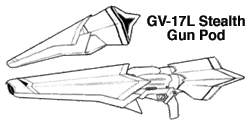
- HOWARD/GENERAL DYNAMICS GV-17L GUN PODS: For
a main external weapon, the YF-21 contains TWO new stealth gatling gun pods
produced by Howard Industries and General Dynamics. These gun pods are exclusively
designed for the YF-21 and are mounted in specially designed storage bays
located on the underside of the craft in fighter mode, similar to the gatling
gun used by the VF-17 Nightmare. In Gerwalk or Soldier modes
the gun pods can be ejected from their bays and used by one or both of the
YF-21's hands. The gun pods can fire in any mode; they fire out of a special
concealed port when stored away in Fighter mode.
Like the original GU-11 gun pod used by the VF-1
Variable Fighters, the GV-17L gun pods do NOT use clips of ammo, but instead
have a large internal supply of ammo stored in the barrel of the pod. This
allows the GV-17L to contain a larger supply of ammo and bypasses the need
to reload while in the field. Once exhausted, the gun pods can only be reloaded
by trained technicians at a supply base.
- PRIMARY PURPOSE: Assault
- SECONDARY PURPOSE: Anti-mecha
- RANGE: 4000 feet (1200 m)
- DAMAGE: Does 4D6 M.D. for a short burst,
1D6x10 M.D. for a long burst, or 2D6x10 M.D. for a full melee burst.
- RATE OF FIRE: Equal to the number of combined
attacks of the pilot.
- PAYLOAD: 800 rounds, equal to 80 short
bursts, 40 long bursts, or 20 full melee bursts. Once depleted, the gun
must be reloaded by a service technician at a UN Spacy base or starship.
- WING HARD POINTS: The YF-21 has four
fixed hard points (two per wing) which can be used to hold a variety of different
ordinance payloads, including long, medium, or short range missiles, or even
the new medium-range high-maneuverability (MRHM) missiles. One long
range, one MRHM, 3 medium range, or 5 short range missiles can be mounted
per hardpoint. Usually long range or MRHM missiles are used.
NOTE: Due to the location of the hard points,
ALL missiles must be fired or ejected before the YF-21 can convert into
soldier mode. For this reason the missiles mounted on the hard points are
usually fired within the first few passes of an attack.
- MEDIUM RANGE HIGH MANEUVERABILITY MISSILES
- Primary Purpose: Anti-Mecha
- Secondary Purpose: Surgical Strikes
- Mega-Damage: 2D6x10 M.D.
- Rate of Fire: One per hardpoint.
- Range: 80 miles.
- Payload: One per hardpoint; 4 maximum.
- LONG RANGE MISSILES
- Primary Purpose: Heavy Assault
- Secondary Purpose: Anti-Spacecraft
- Missile Types: Any type of standard
UN Spacy Long Range Missile can be used.
- Range: Varies with missile type.
- Damage: Varies with missile type.
- Rate of Fire: One or two.
- Payload: One per hardpoint; 4 maximum.
- MEDIUM RANGE MISSILES
- Primary Purpose: Assault
- Secondary Purpose: Anti-Mecha
- Missile Types: Any type of standard
UN Spacy Medium Range Missile can be used.
- Range: Varies with missile type.
- Damage: Varies with missile type.
- Rate of Fire: 1-3 missiles per hardpoint.
- Payload: Three per hardpoint; up to
12 maximum.
- SHORT RANGE MISSILES
- Primary Purpose: Assault
- Secondary Purpose: Anti-Mecha
- Missile Types: Any type of standard
UN Spacy Short Range Missile can be used.
- Range: Varies with missile type.
- Damage: Varies with missile type.
- Rate of Fire: 1-5 missiles per hardpoint.
- Payload: Five per hardpoint; up to
20 maximum.
- HOWARD PBS-03F PIN-POINT BARRIER SYSTEM: The
YF-21 is equipped with a new mecha-scale pinpoint barrier system for
defense. The system can generate a single pinpoint barrier that can be moved
anywhere on the mecha and used as a shield against incoming attacks. The barrier
provides 100 MDC of protection, and regenerates at a rate of 50 MDC per round
when damaged. Even if destroyed by combined attacks, the shield will regenerate
itself within 2 rounds. In order to use the shield, the pilot must make a
successful parry roll to intercept an incoming attack. Due to the tremendous
power requirements of the system, the head and wing lasers on the YF-21 cannot
be used while the barrier is in operation.
- Primary Purpose: Defense
- Protection: 100 MDC total
- Regeneration Rate: 50 MDC per round.
- Size: The barrier can be up to 10 ft (3
m) in diameter.
- Duration: Unlimited.

- HAND TO HAND COMBAT:
If necessary, the YF-21 can engage in melee combat rather than use a weapon.
The new AVF is extremely agile and can execute most typical hand to hand combat
moves, such as punches, jump kicks, leap attacks, rolling with impacts, etc.
DAMAGE:
- Restrained Punch: 1D6 M.D.
- Full Strength Punch: 3D6 M.D.
- "Booster" Punch: 4D6 M.D. (counts as
two attacks)
- Tear or Pry with Hands: 2D4 M.D.
- Kick: 2D4 M.D.
- Leap Kick: 3D6 M.D.
- Body Flip/Throw: 1D6 M.D.
- Body Block/Tackle: 2D6 M.D.
- Stomp: 2D6 M.D. (only effective against small
objects)
STANDARD EQUIPMENT FOR THE YF-21:
- ACTIVE STEALTH SYSTEM: The YF-21 is equipped
with a revolutionary stealth system that when activated renders the craft
almost invisible to standard sensors such as radar. Unlike passive stealth
systems like those used by the VF-17 Nightmare or the old
USAF F-117, the YF-21's stealth system is an
- ACTIVE stealth system that actually bends radar waves
around the mecha rather than reflecting them. When activated, this system
gives the YF-21 a +3 on initiative and a +1 to strike at all times.
NOTE: Since the YF-21's stealth capability is a system
and not a feature of the design, it can be damaged or destroyed. Once the
mecha has lost half of its main body MDC, there is a 50% chance that the stealth
system will fail every time the main body of the craft is hit. Once the stealth
system has failed, it will not work again until repaired at a UN Spacy base.
- AUTO-PILOT: The YF-21 is equipped with a computerized
auto-pilot, allowing the pilot to relax or even sleep during long voyages.
The auto- pilot can be programmed with a single destination or a complex flight
plan involving multiple speeds, directions, and destinations. The onboard
computer will alert the pilot when the fighter is near its destination, and
can also be set to automatically signal when sensors detect objects near the
mecha. The auto-pilot was designed with long intra-system space journeys in
mind.
- BRAIN CONTROL SYSTEM (BCS) :
This revolutionary and experimental system is one of the most unique abilities
of the YF-21. The BCS system allows a disciplined pilot to link his mind with
the onboard computer of the mecha, and issue control commands to it at the
speed of thought. This allows the YF-21 to move with human-like reflexes and
respond with human- like speed. Feedback for the system is transmitted back
to the pilot using the brain-direct imaging (BDI) system (see below), providing
an interactive control loop that literally makes the mecha a part of the pilot.
The disadvantage of the system is that it requires
a fair amount of concentration to use. If the pilot of the YF-21 is suddenly
startled or disturbed, he may lose control of the mecha and be unable to
regain it until he calms himself down. It requires a fairly dramatic event
to startle the pilot sufficiently, such as being physically wounded, seeing
a comrade killed in front of him, or (in Chief Bowman's
case) being suddenly confronted with a despised enemy and suffering a flashback.
If startled, the pilot must roll under his M.E. attribute on a 1D20 to keep
control of the plane. If he fails, the BCS fails and the YF-21 will freeze.
In order to regain control of the BCS, the pilot must calm himself sufficiently,
which requires another successful roll under his M.E. attribute. NOTE:
the GM may impose penalties to the above rolls if the pilot is going through
a VERY traumatic experience while flying the YF-21.
Another disadvantage of the BCS is that when uncalibrated
to a specific user, the system has a tendency to pick up stray thoughts
from the pilot and act upon them without his permission. A particularly
nasty example of this happened during the Project Super Nova tests when
Chief Bowman
imagined slamming Pilot Isamu
Dyson's VF-11 into the ground, and the BCS
picked up and acted on that idle thought. When properly calibrated there
is no danger of this occuring, but when an uncalibrated system is being
used by a pilot during game play, the GM should roll against the player's
M.E. whenever the player makes an idle remark about what he would like to
do with the YF-21 (even if he was just mentioning it in jest). If the GM
rolls above the player's M.E., the YF-21 will do EXACTLY what the player
mentioned, regardless of the consequences.
The cockpit of the YF-21 is equipped with a backup
set of standard aircraft controls in case the pilot looses control of the
BCS and cannot re-establish contact. Initial versions of the BCS were calibrated
specifically for human brain waves, which led to problems when the system
was used by non-human pilots such as Chief Bowmann. Zentraedi or other alien
pilots using a non- calibrated BCS system receive a +5 penalty to their
rolls to keep control of the system.
- BRAIN DIRECT IMAGING (BDI) SYSTEM:
This prototype system, along with the BCS, allows the pilot of the YF-21 to
essentially control the mecha with his thoughts. The BDI system is extremely
important to thought control, as it provides the pilot with visual and tactile
feedback from the mecha, including things such as balance and force feedback.
The BDI essentially makes HUD (heads-up display) and HMD (head mounted display)
technology obsolete since instead of overlaying a display with computer- generated
graphics the pilot can receive direct sensory input with computer analysis
and highlights directly into his brain. In game terms, this provides the pilot
of the YF-21 with a +20% bonus to any skill rolls made to control the mecha,
a +2 bonus to dodge and a +1 bonus to strike.
The BDI system does have a drawback, however. Human
(and Zentraedi) brains were not designed to accept this type of intense input,
and use of the BDI system can lead to stress, fatigue, and headaches. Frequent
use of the BDI can even lead to stress-induced tramua-like symptoms manestifying
themselves such as sleeplessness, frequent migraines, shaky hands, cold sweats,
and short tempers/emotional problems. After each week of frequent use of the
BDI system, the pilot must roll under his P.E. stat or the character will
begin to exhibit one of the above symptoms (GMs choice). The base medical
officer can prescribe drugs to surpress the symptoms, but the only way for
the pilot to be cured is to stop using the BDI system. It is not known what
long-term use of the BDI system without breaks will do to a pilot.
NOTE: Although the cockpit of the YF-21 does
NOT contain any windows except a top-mounted radome (the BDI makes windows
unnecessary, theoretically), a backup display monitor is included for the
pilot in the event of BDI system failure. This monitor, while acceptable as
an emergency backup, is not well designed for a combat fighter, and being
forced to rely solely on it imposes a -3 penalty to hit and dodge rolls by
the pilot.
- COMBAT COMPUTER: The YF-21 is equipped with
a combat computer that can store and analyze data during combat with hostile
forces. Data collected by the combat computer can be viewed by the pilot either
on standard HUD displays mounted on the cockpit viewports, or using the new
BDI system (see above). This allows the computer to display large amounts
of data to the pilot and even highlight enemies and missile attacks with overlaid
graphics. The combat computer tracks and identifies specific enemy targets,
and has a database of over 10,000 images stored in memory. The computer can
identify and track up to 250 targets simultaneously.
- DETATCHABLE LIMBS: The arms and legs of the
YF-21 are detatchable, so that in the event one or more of the limbs of the
mecha are damaged they can be ejected from the main body so as to avoid creating
atmospheric drag or preventing transformation. The YF-21's arms and legs don't
contain any critical systems so the AVF's performance will be unaffected if
they are jettisoned. However, the YF-21 will not be able to hold its GV-17L
gun pod in gerwalk or soldier mode if both arms are ejected.
- ESCAPE POD: The entire reinforced cockpit of
the YF-21 is a detachable escape pod that can be jettisoned when the mecha
is destroyed. The ejected cockpit does not contain thrusters, but does contain
a powerful locator beacon and an integrated life support system that can support
the pilot for up to 24 hours after ejection. The pod is also equipped with
parachutes in case of ejection in an atmosphere. The combat computer is programmed
to automatically eject the escape pod if the mecha is destroyed (main body
MDC reduced to 0), but this can be overridden if the pilot is feeling suicidal
for some reason.
- EXTERNAL AUDIO PICKUP: Range: 300 ft (91.5
m). A sound amplification system that can pick up normal conversation up to
300 feet away.
- HEAT AND RADIATION SHIELDS: Special shielding
prevents the penetration of life threatening head and radiation. A radiation
detection and alarm system are linked with the shields and will sound an alarm
if there is a rupture in the shields and what the levels of radiation are.
- HOMING SIGNAL: The escape pod of the YF-21
is equipped with a homing device that enables rescue teams to locate a disabled
craft or ejected life pod. The range of the signal is 400 miles (640 km).
Most UN Spacy ships and variable fighters can locate and track homing signals,
and the onboard computers will automatically notify their pilots if such a
signal is detected.
- LASER TARGETING SYSTEM: Range: 100 miles (160
km). Used for increased accuracy in the striking of enemy targets and is partly
responsible for the mecha's strike bonus.
- LOUDSPEAKER: A loudspeaker system is built
into the craft, which can be used to amplify the pilot's voice up to 90 decibels.
- OPTICS: WIDE-SPECTRUM SENSORS: Range: 2000
feet (610 m). This new active/passive optical system is able to view and project
light from any portion of the visible and invisible spectrum, from infrared
to ultraviolet and everything in between. Among other things, this system
allows the pilot to see in the dark or through smoke using infrared, through
water or fog using ultraviolet, and even detect heat emissions from concealed
targets. The sensors can use either an active or passive scanning mode. In
active mode, the YF-21 actually projects a beam of light (visible or invisible)
and views the reflection off objects. In passive mode, the sensors simply
receive data without emitting light. Active mode provides more detailed pictures,
but passive mode reduces the risk of detection by IR or UV sensors. The system
provides the pilot with a bonus of +10% when tracking or trying to detect
an ambush. Results of the scans can be viewed either on HUD displays or using
the BDI system.
- RADAR: 200 mile (321 km) range.
- RADIO/VIDEO COMMUNICATION: Long range, directional
communications system with satellite relay capabilities. Range: 600 miles
(960 km) or can be boosted indefinitely via satellite relay.
- SELF-DESTRUCT: To prevent capture of a Variable
Fighter fighter by the enemy, the pilot can activate the YF-21's self-destruct
system, which will cause the fighter to explode after a delay of up to 60
minutes (time is set by the pilot). The explosive damage is contained within
a 20 foot (6 m) area and inflicts 1D6x10 M.D. to everything within the radius
of the explosion. All internal systems are obliterated. The escape pod will
be automatically ejected prior to the explosion unless the pilot overrides
the ejection sequence.
- STANDARD SURVIVAL KIT: All UN Spacy Variable
Fighters come equipped with a portable survival kit. Inside the small reinforced
box is a medium-sized flashlight, two hand flares, one rocket flare, a compass,
infrared distancing binoculars, a small mirror, a pocket knife, dehydrated
and concentrated food (can be stretched into a five day supply for one person)
and basic first aid items (aspirin, bandages, disinfectants, etc.)
- TACTICAL LIFE SUPPORT SYSTEM: The YF-21's cockpit
is pressurized, and also provides additional air feeds to the pilot's flight
suit that provides him with pressurized breathing. The UN Spacy flight suit
also contains an upper and lower g-suit that promotes blood circulation even
during high-g turns, thus decreasing the possibility of pilot's blacking out
in combat.
COMBAT BONUSES FOR YF-21 FIGHTER TRAINING:
NOTE: Due to the prototype nature of the YF-21,
it is highly recommended that no player be allowed to start the game with
YF-21 BDI/BCS combat training (unless the GM is running a very unusual campaign).
Untrained pilots should get bonuses equal to Basic Variable Fighter Combat
Training when piloting the YF-21, and military pilots with no prior YF-21
experience should get full bonuses from Advanced VF-11 Variable Fighter
Combat Training. However, this only applies to players trying to fly the
YF-21 with conventional controls; characters trying to fly a YF-21 using the
BDI/BCS systems for the first time only get Basic Variable Fighter
Combat Training bonuses regardless of their experience! The
BDI/BCS systems take immense amounts of training and discipline to be used
at maximum efficiency.
The below bonuses only apply to trained characters
piloting a YF-21 using the BDI/BCS systems. Players should only be allowed
to get this training when their characters have accumulated enough experience
to acquire new skills. Pilots trained on non-BDI/BCS versions of the YF-21
should use the bonuses for VF-22 Sturmvogel combat training.
ADVANCED YF-21 BDI/BCS AVF COMBAT TRAINING
- Advanced training for pilots specializing in the YF-21
and trained to take full advantage of the Brain Control System and Brain Direct Imaging systems of the prototype.
- 4 attacks per melee (plus those of the pilot).
- Add one additional action/attack at levels two, five,
seven, and ten.
- +2 on initiative (+5 when using Active Stealth System)
- +3 to strike (+4 when using Active Stealth System)
- +4 to parry
- +3 to dodge in solder mode, +5 in gerwalk, +7 in jet
mode.
- When using BDI/BCS, add +2 to dodge and +1 to strike
to above bonuses.
- +3 to roll with a punch or fall with an impact, reducing
damage by half.
- +4 to leap dodge. A leap dodge is an automatic dodge
which causes no loss of attacks per melee. The new generation AVFs are so
maneuverable that the pilot can dodge an attack while moving to counterattack
an enemy.
- Critical strike same as pilot's hand-to-hand.
- Body block/tackle/ram - 2D4 M.D. plus a 50% chance
of knocking an opponent down, causing him to loose initiative and one attack
that melee round.
REFERENCES USED IN THIS DESIGN
- "Doe's All The Worlds' Mecha Guide: General
Galaxy YF-21 Reference Entry"
- Macross Plus episodes 1-4
- This is Animation Special: Macross Plus
- This is Animation The Select: Macross Plus Movie
Edition