The following material is an adaptation
of mecha from MACROSS PLUS, a sequel to the original Japanese MACROSS
TV series (which became Robotech in the U.S.).
X-9 GHOST UNMANNED FIGHTER
(PROTOTYPE) STATS
BACKGROUND
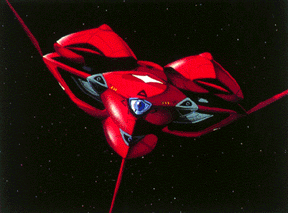 The X-9 Ghost is a top secret unmanned
high performance transatmospheric prototype fighter developed in 2039 by the
UN Spacy and the Macross Consortium. The Ghost was the brainchild of
General Gomez, who wanted to develop a way to expand UN Spacy military might
while decreasing the costs of training and maintaining fighter pilots. Unmanned
fighters promised to be an ideal solution to this problem. They could be mass-produced
in greater numbers and were far less costly than recruiting and training new
pilots, and could be sent into combat and high-risk situations without endangering
human lives. General Gomez was secretly working on the Ghost fighter at the
same time he was overseeing the Project Super Nova design contest, intended
to develop a new manned advanced variable fighter (AVF) for the UN Spacy. However
once the prototype X-9 was perfected he cancelled the Super Nova contest (before
a winning design was selected) and planned to unveil the Ghost at the UN Spacy's
Armistice 30th Anniversary celebration on Earth.
The X-9 Ghost is a top secret unmanned
high performance transatmospheric prototype fighter developed in 2039 by the
UN Spacy and the Macross Consortium. The Ghost was the brainchild of
General Gomez, who wanted to develop a way to expand UN Spacy military might
while decreasing the costs of training and maintaining fighter pilots. Unmanned
fighters promised to be an ideal solution to this problem. They could be mass-produced
in greater numbers and were far less costly than recruiting and training new
pilots, and could be sent into combat and high-risk situations without endangering
human lives. General Gomez was secretly working on the Ghost fighter at the
same time he was overseeing the Project Super Nova design contest, intended
to develop a new manned advanced variable fighter (AVF) for the UN Spacy. However
once the prototype X-9 was perfected he cancelled the Super Nova contest (before
a winning design was selected) and planned to unveil the Ghost at the UN Spacy's
Armistice 30th Anniversary celebration on Earth.
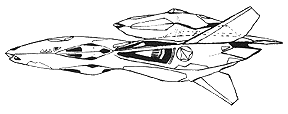
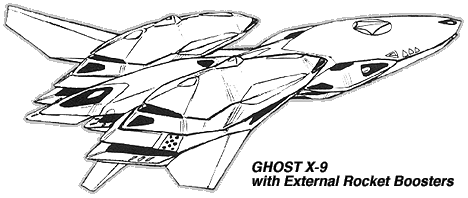
The X-9 Ghost is an extremely advanced combat fighter. Approximately half the
size of a standard variable fighter, the Ghost mounts three revolutionary thermonuclear
turbine engines and numerous maneuvering verniers that give the fighter incredible
speed and agility both in an atmosphere and in space (and the Ghost can be mounted
with FAST packs for additional thrust if necessary). The armament for the drone
is more modest but still impressive, including five pulse lasers and 29 high-maneuverability
micro-missiles. In combat the Ghost relies on its speed and maneuverability
to conduct hit-and-run attacks on multiple targets, allowing it to often take
out entire squadrons before the enemy has a chance to retaliate. But the most
impressive feature of the fighter is its onboard AI (artificial intelligence)
computer system. The X-9 can be piloted by remote control from a UN Spacy starship,
or can be allowed to operate autonomously in combat. The AI system is quick,
clever, and almost savage in the ferocity of its attacks. The system uses bio-neural
circuitry modeled after a human brain, which permits the AI both to formulate
new plans and strategies on the fly as well as learn during combat to improve
its performance. The combination of the Ghost's intelligence, speed, and weaponry
make the small drone extremely deadly in combat, able to hold its own against
even advanced VFs such as the VF-19 Excalibur and
VF-22 Sturmvogel.
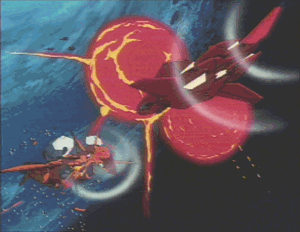
The prototype Ghost fighter was taken over by the renegade AI Sharon Apple
during the Armistice celebration and used against the YF-19
and YF-21
prototypes which had travelled from Eden to Earth. After an extended aerial
combat pilot Guld Goa
Bowman managed to defeat the X-9 at the cost of the YF-21 and his own
life. Although the project was not cancelled immediately after the incident,
unexpected problems appeared during later testing of additional Ghost prototypes.
The bio-neural circuitry of the drone possessed an erratic self-preservation
tendency that sometimes caused the AI to disobey orders, even to the point of
attacking other drones that were supposed to be fighting on the same side in
mock combats. In addition, simulated engagements with experienced pilots in
VF-19 Excalibur prototypes resulted in victory
for the Ghost fighter only 55% of the time, leading to debate about whether
the drone was actually superior to piloted variable fighters. Eventually the
X-9 Ghost was turned down by the UN Spacy as a replacement for manned fighters.
However AI research continues at the Macross Consortium, so it may only be a
matter of time before a new Ghost fighter is produced that is superior in every
way to combat pilots.
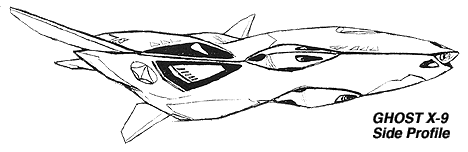
RPG STATS
Vehicle Type: X-9 Ghost
Class: Advanced Unmanned Fighter Drone (Prototype)
Manufacturer: UN Spacy/Macross Consortium
Crew: None! Can be controlled remotely by a pilot or operated
autonomously via AI.
MDC BY LOCATION:
(1) Front Sensor Eye                                     15
    Vernier/Weapon Clusters (3)                          35 each
(2) Engine Nacelles (2)                                 125 each
(3) Main Body                                           200
    Wings (3)                                            60 each
    FAST Augmentation Packs (2, optional)                75 each
NOTES:
- Destroying the sensor eye of the X-9 will knock out the drone's major sensor
systems (including infrared, night vision, and thermal). Radar and communications
will be unaffected, but the Ghost will be at -4 to strike. The sensor eye
is a very difficult target to hit, however; -5 to strike in addition to velocity
penalties.
- Depleting the MDC of one engine nacelle will reduce the Ghost's speed by
40% and give it a -3 penalty to dodge. Depleting the MDC of both nacelles
will reduce speed by 80% and impose a -6 penalty to dodge. There is a third
engine in the main body that will enable the Ghost to keep flying even if
both nacelles are destroyed, however.
- Depleting the MDC of the main body will disable the Ghost. If controlled
by the onboard AI the Ghost will self-destruct to avoid capture by an enemy.
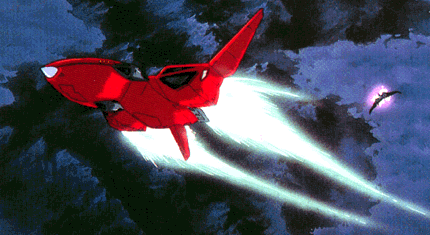
SPEEDS:
- ATMOSPHERIC FLIGHT SPEED:
- Mach 4.0+ (2680 mph/4082 kmph) max speed at 10,000 meters or less above
sea level. Mach 5.8+ (3886 mph/5916 kmph) max speed at 10,000-30,000 meters
above sea level. Mach 25+ (16,750 mph/25,500 kmph) max speed at 30,000+ meters
above sea level, for a maximum of 5 seconds. Cruising speed is usually Mach
2 (1340 mph/2040 kmph). The Ghost is capable of achieving orbital velocity
over an Earth-class planet without additional rocket assistance. Maximum rate
of ascent is 68,000 meters/minute. Structural G limits are +40.0 to -25.0
Earth gravities. Note: The Ghost cannot hover in place like a VF and
must maintain a minimum speed of 100 mph (152 kmph) to remain airborne.
STATISTICAL DATA:
LENGTH: 34.54 ft (10.80 m)
WIDTH: 21.41 ft (9.23 m)
HEIGHT: 12.85 ft (5.54 m)
- WEIGHT:
- 3,940 kg empty. Maximum takeoff weight in an atmosphere without booster
assistance is 13,800 kg.
-
- CARGO:
- None, unless missiles are removed from ventral missile bay. If the missiles
are removed the Ghost can carry up to 1,450 kg of cargo.
WEAPON SYSTEMS:
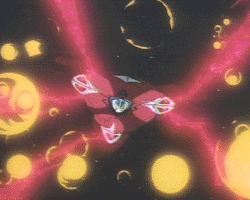
- PULSE LASER CANNONS: The main weapons of the X-9 Ghost are five powerful
pulse laser cannons. Four are mounted in banks of two on either side of the
drone, while one slightly more powerful one is mounted in the bottom of the
aircraft. All five lasers can be fired separately or in combination, against
single or multiple targets. The lasers are semi-fixed forward, and can only
fire within a 40 degree arc from the front of the aircraft.
- PRIMARY PURPOSE: Assault, Anti-mecha
- SECONDARY PURPOSE: Air-to-ground strafing runs
- RANGE: 8000 feet (2400 m)
- DAMAGE: 3D6 M.D. per side laser, 1D6x10 from lower laser. If
all 5 lasers are fired at a single target the combined blast does 3D6x10
M.D.
- RATE OF FIRE: The pulse lasers can fire up to 4 blasts per round
each (however, bursts are not allowed). The lasers may be fired in any
combination at a single target (roll as one blast) or may be fired individually
at separate targets.
- PAYLOAD: Unlimited.
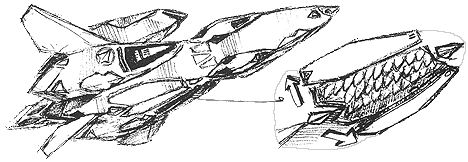
- VENTRAL MISSILE BAY: For additional offensive power, the X-9 Ghost
has a concealed missile bay mounted on the bottom of the aircraft between
the engine nacelles. When launched, the doors concealing the bay open and
the missiles fire downward out of the craft, where they then move to intercept
targets either in front of or behind the drone. The missile bay is designed
to use the new Bifors BMM-24 all-environment high-maneuverability micro-missiles,
but can use any type of UN Spacy mini-missile if HMMMs are not available.
- Primary Purpose: Anti-mecha
- Secondary Purpose: Assault
- Missile Types: Any type of standard UN Spacy Mini-Missile,
including the BMM-24 HMMM. BMM-24s are standard
issue for the X-9 Ghost prototype.
- Range: Varies with missile type.
- Damage: Varies with missile type.
- Rate of Fire: Can be fired individually or in volleys of any
number (2-29) of missiles. If necessary, all 29 missiles can be fired
in a single volley.
- Payload: 29 missiles total.
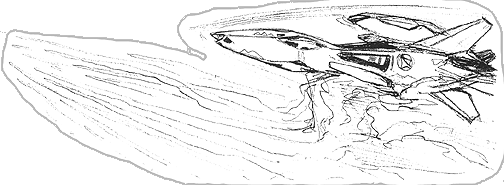
- FAST PACK ANTI-SENSOR PODS: The optional FAST boosters for the X-9
Ghost each contain a combination chaff/flare pod that can be used disrupt
 optical sensors and radar on both
missiles and attacking fighters. Each booster contains one anti-sensor pod
that can be ejected at any time during combat, even if the Ghost has lost
initiative for that round.
optical sensors and radar on both
missiles and attacking fighters. Each booster contains one anti-sensor pod
that can be ejected at any time during combat, even if the Ghost has lost
initiative for that round.
- Primary Purpose: Defense
- Secondary Purpose: Concealment
- Game effects: When jettisoned, the pod explodes and releases
both chaff and flares, confusing all sensors of enemy craft. Any missiles
fired at the Ghost AUTOMATICALLY MISS (regardless of number of missiles)
and are lost. In addition, the Ghost AUTOMATICALLY wins initiative and
gets to strike first in the following combat round. The Ghost can use
the pods at any time during a combat round, even if the drone has lost
initiative.
- Damage: None, other than effects described above.
- Payload: 2 pods, one per FAST pack.
STANDARD EQUIPMENT FOR THE X-9 GHOST:
- ACTIVE STEALTH SYSTEM: True to its name, the Ghost contains an active
stealth system similar to the one used by the YF-19 and YF-21 advanced variable
fighters. Unlike passive stealth systems used by the VF-17 Nightmare or the
old USAF F-117, the X-9's stealth system is actually bends radar waves around
the mecha rather than reflecting them. The Ghost's stealth system is not quite
as good as the YF-21's due to sacrifices that had to be made in order to fit
the system into the drone's fuselage. When activated, this system gives the
Ghost a +3 on initiative (but no bonus to strike) at all times.
NOTE: Since the Ghost's stealth capability is a system and not a
feature of the design, it can be damaged or destroyed. Once the drone has
taken 40 points of damage to its main body MDC, there is a 50% chance that
the stealth system will fail every time the main body of the craft is hit
from then on. Once the stealth system has failed, it will not work again
until repaired at a UN Spacy base.
- ARTIFICIAL INTELLIGENCE (AI) COMBAT COMPUTER: The
X-9 Ghost is equipped with the UN Spacy's most advanced AI combat computer
available, which allows the drone to operate autonomously during missions
without input from human controllers. The AI computer is smart enough to devise
new strategies and use subterfuge to win battles if unexpected events happen
or of the odds turn against the drone. In addition, the computer learns to
anticipate and counter enemy maneuvers during combat. For every 5 rounds the
Ghost is engaged in combat against a foe, the X-9 gets a +1 to initiative
(cumulative) for the remainder of combat. This bonus is only valid when the
Ghost is solely piloted by the AI; if a technician takes over remote control
of the craft the bonus is lost.
The AI computer of the Ghost is not without its faults and problems, however.
The computer uses bio-neural circuitry patterned after the human brain,
which unfortunately has tendencies for self-preservation and illogical behavior
during combat. Any time the Ghost receives over 30 points of damage in a
single round, roll on the percentile table below to see if the AI malfunctions.
- 01-65: No malfunction.
- 65-75: The Ghost breaks off combat and retreats at maximum possible
speed.
- 75-85: The Ghost locks onto a single enemy target and tries to
destroy it at all costs. It will ignore any other enemy craft (even if
attacked by them) and will even try to ram the chosen enemy if it is out
of weapons. If the target is destroyed the Ghost will return to normal
operation.
- 85-95: The Ghost goes berserk and attacks any aircraft (military
or civilian) it can detect, regardless of alignment. Controllers at a
UN Spacy base can regain control of the Ghost if they make a successful
Computer Operations roll at -20% to skill.
- 95-00:As above, but the Ghost will no longer respond to remote
control signals. The drone will go on a rampage and attack any aircraft
it can detect until it is destroyed.
- LASER TARGETING SYSTEM: Range: 100 miles (160 km). Used for increased
accuracy in the striking of enemy targets and is partly responsible for the
drone's strike bonus.
- OPTICS: INFRARED: Range: 2000 feet (610 m). This optical system projects
a beam of infrared light that is invisible to the normal eye, but detectable
by the Ghost's sensors. The system allows the drone to detect hidden/concealed
objects by their IR reflectiveness. The beam will be visible to anyone with
IR sensitive optics, however.
- OPTICS: NIGHTVISION: Range: 2000 feet (610 m). A passive light image
intensifier that emits no light of its own, but relies on ambient light which
is electronically amplified to produce a visible picture.
- OPTICS: THERMAL IMAGER: Range: 2000 feet (610 m). A passive optical
heat sensor that detects infrared radiation projected by warm objects and
converts that data into a false-color visible image. The system enables the
drone to see in the dark, in shadows, and through smoke, and also adds a +10%
bonus if the drone is trying to track a ground-based target.
- RADAR: 200 mile (321 km) range.
- SCRAMBLER RADIO COMMUNICATION: The Ghost is equipped with a long
range, omni-directional communications system with satellite relay capabilities
that allows it to stay in contact with a controlling UN Spacy base. The signal
is encrypted so that it cannot be intercepted by an enemy (and then used to
take control of the Ghost), but it can be jammed by ECM systems. If the Ghost
looses contact with its controllers the drone's AI system will automatically
engage. Range: 600 miles (960 km) or can be boosted indefinitely via satellite
relay.
- SELF-DESTRUCT: To prevent capture of the drone by the enemy, the
Ghost is equipped with a self-destruct system. When detonated, the craft will
generate an explosion that will do 3D6x10 M.D. to everything within a 40 foot
(12 m) area. The Ghost will be completely obliterated by the explosion and
will not be salvageable. If the Main Body MDC of the Ghost reaches 0 the AI
will automatically activate the self-destruct system.
COMBAT BONUSES FOR X-9 GHOST FIGHTER TRAINING:
 NOTE: As mentioned above, the X-9 Ghost can operate
autonomously or can be directed via remote control from a UN Spacy base or starship.
The stats below represent bonuses for operators trained in remote control operation
of the Ghost fighter. In order to have X-9 Ghost combat training the controller
must also have the following skills: Computer Operation, Radio: Scrambler,
Read Sensory Instruments, Pilot: Jet Fighter (or Pilot: Variable
Fighter), and Weapon Systems. Untrained operators attempting to control
a Ghost fighter only get bonuses equivalent to VF-11 Thunderbolt
Basic Training.
NOTE: As mentioned above, the X-9 Ghost can operate
autonomously or can be directed via remote control from a UN Spacy base or starship.
The stats below represent bonuses for operators trained in remote control operation
of the Ghost fighter. In order to have X-9 Ghost combat training the controller
must also have the following skills: Computer Operation, Radio: Scrambler,
Read Sensory Instruments, Pilot: Jet Fighter (or Pilot: Variable
Fighter), and Weapon Systems. Untrained operators attempting to control
a Ghost fighter only get bonuses equivalent to VF-11 Thunderbolt
Basic Training.
ADVANCED X-9 GHOST COMBAT TRAINING
- Advanced training for controllers of the X-9 Ghost drone.
- 4 attacks per melee (plus those of the pilot).
- Add one additional action/attack at levels three, six, nine, and twelve.
- +3 to strike
- +6 to dodge.
- +3 to roll with an impact, reducing damage by half.
- Critical strike same as pilot's hand-to-hand.
- Full-speed Ram - Does 1D6x100 M.D. to BOTH the Ghost fighter and the target.
Used as a suicide attack only.
If the Ghost is put in autonomous operation mode (fully controlled by the AI
computer) then the X-9 has the following skills, abilities, and bonuses (treat
as a 6th level Variable Fighter pilot):
X-9 GHOST AI COMBAT STATS
- Nine (!) Attacks per Melee
- +2 on initiative (+5 with active stealth), plus learning bonuses (see AI Computer entry).
- +5 to strike
- +9 to dodge
- +5 to roll with an impact, reducing damage by half.
- Critical strike on an unmodified roll of 18, 19, or 20.
- Full-speed Ram - Does 1D6x100 M.D. to BOTH the Ghost fighter and the target.
Used as a suicide attack only.
- Skills of note:
- Optic Systems (80%)
- Detect Ambush (80%)
- Detect Concealment (75%)
- Tracking (75%)
- Navigation (90%)
REFERENCES USED IN THIS DESIGN
- Macross Plus episodes 3 and 4
- This is Animation The Select: Macross Plus Movie Edition